

Ease of Movement (EMV)
How easily the price is moving: a large move on little volume scores high.
What it measures
Section titled “What it measures”Richard Arms’ Ease of Movement divides the change in the bar’s midpoint by a “box ratio” of volume to range, then averages it. Volume is divided by 100,000,000, a scale chosen for share volumes, so on forex the values are small numbers. Volume here is the volume the price feed reports for each bar. For forex, brokers usually report the number of price updates in the bar, not an amount traded, so read it as activity rather than money.
How traders read it
Section titled “How traders read it”Traders read a value above zero as the price rising easily and below zero as falling easily. Values near zero mean the price needs a lot of volume to move.
Formula
Section titled “Formula”distance moved = (high + low) / 2 − previous (high + low) / 2box ratio = (volume / 100,000,000) / (high − low)EMV = SMA(distance moved / box ratio, periods)Settings and output
Section titled “Settings and output”Call: emv(periods)
| Setting | Chart default |
|---|---|
periods: Periods |
14 |
What you get: a number.
Warm-up: with emv(14), it asks for 0 bars of history and a run-up of 15, and its first value came on bar 15 of the example data.
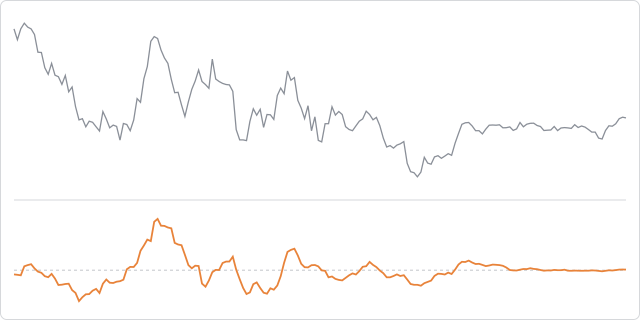
The prices are made up, hourly, and the same on every page, so the chart shows how the indicator behaves, not how a market behaved.
In an algorithm
Section titled “In an algorithm”function onIntervalClose() { if (OPEN_POSITIONS_COUNT === 0 && emv(14) > 0 && CLOSE > sma(50)) { openPosition("BUY", { quantity: 10000, stopLossPips: 25, takeProfitPips: 50 }); }}